Article Overview
This paper investigates the modeling, optimization, and motion control of an energy-efficient two-module vibration-driven robot. The robot consists of two masses connected by a spring and moves along a straight path through actuation by an unbalanced rotating mass.
The governing dynamics are simulated in MATLAB/Simulink and verified through comparison with MSC Adams results. A parametric study examines the influence of physical design variables on average velocity and energy consumption. The design parameters are then optimized using the NSGA-II genetic algorithm.
For trajectory tracking, proportional–integral–derivative (PID) and fractional-order PID controllers are designed. Both controllers are tuned using a genetic algorithm that considers tracking error and control effort, and their performances are compared.
Key Features
- Dynamic modeling and verification: Develops the robot’s equations of motion and compares MATLAB/Simulink predictions with MSC Adams simulations.
- Energy-aware design optimization: Uses NSGA-II to select design parameters based on locomotion and energy-consumption objectives.
- Motion control: Optimizes and compares PID and fractional-order PID controllers for trajectory tracking.
Figures
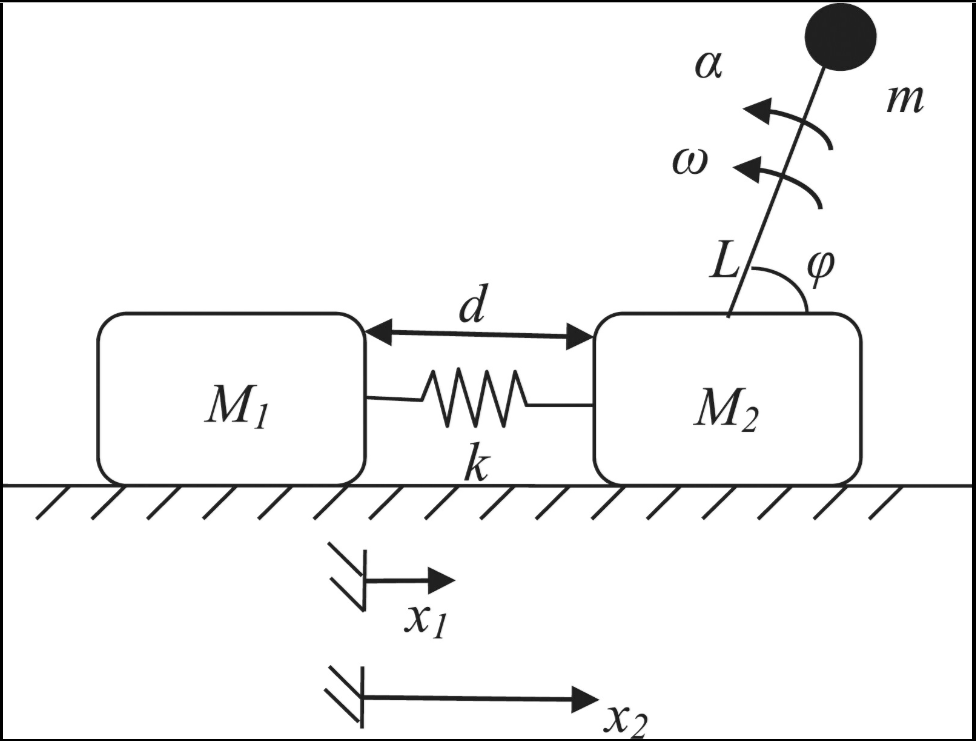
Schematic of the analyzed vibration-driven robot
Read More
Read the full paper.
Citation
@article{amiri2024optimization,
  title={Optimization and control of an energy-efficient vibration-driven robot},
  author={Amiri, Niloufar and Sohrabi, Kourosh and Eftekharian, Ghazal and Fakhari, Vahid},
  journal={Journal of Vibration and Control},
  volume={30},
  number={9-10},
  pages={2184--2199},
  year={2024},
  publisher={SAGE Publications Sage UK: London, England}
}