Article Overview
This study develops a convolutional neural network (CNN)-based keypoint detector to support deep visual servoing (DVS) without relying on fiducial markers. Conventional image-based visual servoing (IBVS) is first evaluated in physical experiments using markers. A learned detector is then designed to identify the corners of more realistic target objects.
A dataset is collected using a camera mounted on the robot’s end-effector as the manipulator moves through its workspace. The images are automatically labeled and augmented through rotation and flipping. Starting from an ImageNet-pretrained VGG-19 model, the feature-extraction layers are kept fixed while the fully connected layers are trained to estimate keypoint coordinates.
Replacing max-pooling with average-pooling and introducing a progressively decreasing learning rate reduce validation loss by 50%. The model is further evaluated using k-fold cross-validation.
Key Features
- Marker-free keypoint detection: Develops a CNN to identify object corners for visual servoing.
- Automated dataset preparation: Collects, labels, and augments images from an eye-in-hand robotic setup.
- Improved CNN training: Adapts VGG-19 with average-pooling and a decreasing learning rate, followed by cross-validation.
Figures
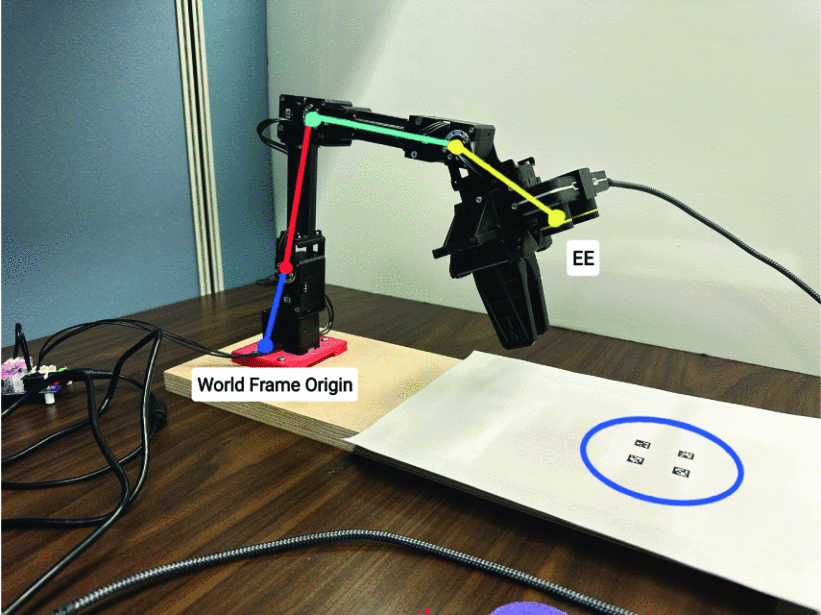
Camera mounted on the robot in an eye-in-hand configuration.
Read More
Read the full paper.
Citation
@inproceedings{amiri2024keypoint,
  title={Keypoint Detection Technique for Image-Based Visual Servoing of Manipulators},
  author={Amiri, Niloufar and Wang, Guanghui and Janabi-Sharifi, Farrokh},
  booktitle={2024 IEEE 20th International Conference on Automation Science and Engineering (CASE)},
  pages={3557--3562},
  year={2024},
  organization={IEEE}
}