Article Overview
This paper investigates robust image-based visual servoing (IBVS) for a quadrotor tracking a moving ground vehicle. A camera rigidly attached to the UAV provides visual features derived from the zeroth-, first-, and second-order moments of a binary target image. These features encode position- and yaw-related information for feedback control.
The image-feature error is used to generate a desired thrust vector for tracking. To compensate for variations in target velocity and UAV payload, a self-organizing neural network (SONN) is incorporated into the control architecture.
The approach is evaluated through ROS–Gazebo simulations and real-world flight experiments. Closed-loop stability is analyzed using Lyapunov theory while accounting for the modeled uncertainties.
Key Features
- Image-moment-based control: Uses visual features associated with UAV position and yaw to guide tracking.
- Adaptive uncertainty compensation: Incorporates an SONN to address changes in target velocity and payload.
- Experimental evaluation and stability analysis: Combines physical flight tests with ROS–Gazebo simulations and Lyapunov-based analysis.
Figures
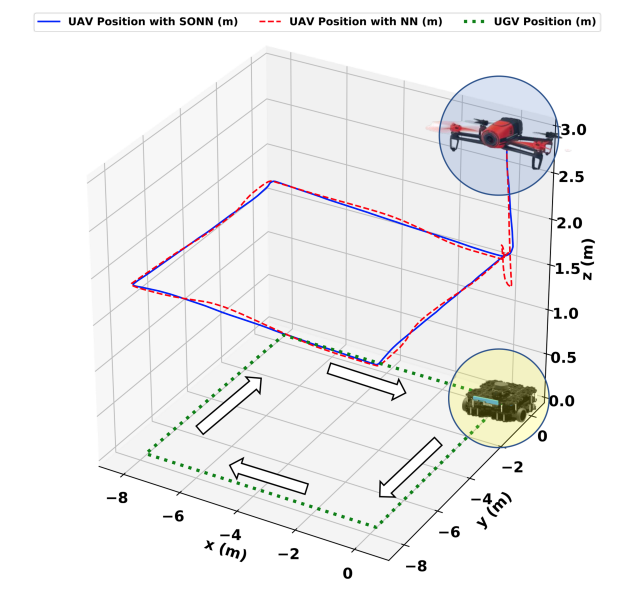
UAV tracking the trajectory of a moving ground vehicle.
Read More
Read the full paper.
Citation
@article{sepahvand2024robust,
  title={Robust Image-based Visual Servoing of an Aerial Robot Using Self-organizing Neural Networks},
  author={Sepahvand, Shayan and Janabi-Sharifi, Farrokh and Masnavi, Houman and Aghili, Farhad and Amiri, Niloufar},
  journal={International Journal of Control, Automation and Systems},
  volume={22},
  number={12},
  pages={3762--3776},
  year={2024},
  publisher={Springer}
}